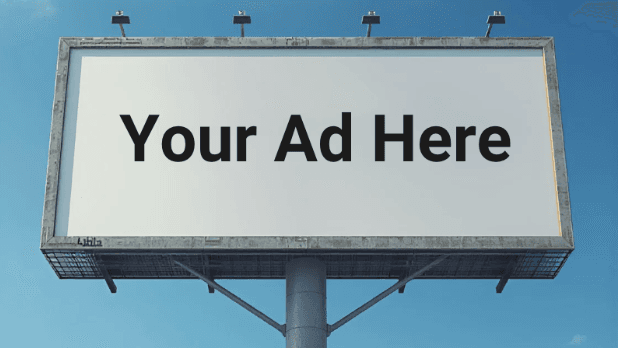
All advertising is advertising for advertising.
The average person encounters 4,000-10,000 ads daily. How is that okay?
by Ali Rahman
I was having a rough go the other day, feeling low and overwhelmed. The state of the world gets to me sometimes. Maybe it was precipitated by the illegal attacks on Iran and all the other displays of naked US imperialism abroad. Or perhaps it was the bleak unemployment statistics at home. Or maybe it was the cumulative wear of a harsher than usual winter, brutal temperatures and excessive precipitation that I cannot in my mind unlink from the realities of climate change. Pick your poison, I guess. We live in the era of polycrisis.
I try though. I try to cultivate what Gramsci calls "pessimism of the intellect and optimism of the will”. On that particular day, my will was faltering. It needed restoration, refreshing. The most reliable source of spiritual rejuvenation for me is the forest. I drove up to my friend’s place in the country. Her property abuts the outer edge of Gatineau park, so it's a short walk from her house into the woods. It was during that warm spell week before last; the false spring that fools me every year. It was a glorious day, sunbeams breaking through thick pine, snow turning supple and wet before sublimating, giving the air a soft, humid texture. I spent the day up there. No meaningful cell signal, just enough to get GPS, but no data. The rhythm of the slow, consistent trudge of my snowshoes through thick snow was meditative. The forest was, as it so often is, a break from worldly concerns, bad news and the quickening heartbeat of a planet in the midst of a panic attack.
The rehabilitative power of the forest comes in the form of both presence and absence. Presence, in that the forest is teeming with life from different kingdoms, interacting across multiple time horizons, from the soil to the canopy. It sounds obvious but bears acknowledgement that being in the forest means being in the company of thousands and thousands of trees twice as old as my oldest grandmother was when she passed. Much of Gatineau Park’s current canopy dates back to the end of a period of intense logging in the 1830s. These trees have seen some shit. Nations falling, empires crumbling, two world wars. Somewhere in their rings they bear the permanent record of the first nuclear tests in the form of a pulse of Carbon-14, known as the atomic souvenir. And still they stand, doing what they always have. It’s reassuring to be in their company.
The absences the forest affords are equally restorative. There is no litter, no concrete, no truck exhaust, no blaring horns. There is no daily grind, no email, no news, no doomscrolling.
I could go on and on about my old friend the forest, but I will save that for another piece. Today, I want to zoom in on one absence in particular: the absence of advertising. We live in adworld. Our built environment is saturated with advertising. Our media landscape is worse, and our digital world has mostly been captured by platforms whose primary purposes are to extract behavioural data from us only to use it to bombard us relentlessly with all manner of ads, constantly rolling out novel formats to keep us off-guard, for maximal manipulative effect.
Advertising is so ubiquitous in our lives we’ve come to regard it as a natural feature of human society. We’re so immersed in it that we can scarcely see it at all, and in turn lose the ability to question the assumptions that have allowed it to seep into nearly every aspect of our lives. Its corrosive effects become invisible precisely because we’ve normalized its omnipresence. It is only when we step outside of adworld that we begin to see just how strange its landscape really is.
Advertising is by definition non-consensual.
So what is advertising, really? Strip away the branding, the aesthetics, the cleverness, and it becomes something much simpler: information directed at people who did not ask for it. If I want to know something, I seek it out. Advertising works in the opposite direction. It inserts itself into my field of attention whether I want it there or not. It is, by design, non-consensual.
And not incidentally so. Advertising depends on reaching people who aren’t asking. If everyone were already seeking something out, there would be no need to advertise at all. Its function is to interrupt, to insert itself, to create desire where there was none, or redirect it where it already exists. It is the art of gaining access to attention that was never freely given.
And attention is bloody precious. Where attention goes energy flows, as they say. In sufficient quantities attention can crystallize into focus, then concentration and then even, flow. And it is a finite resource.
Every advertisement does more than sell the thing it’s selling. It trains us to accept the conditions under which it appears. Each interruption reinforces the same idea: that our attention is always available, to be taken, shaped, redirected. This is why all advertising is advertising for advertising. It normalizes the idea that your attention is a commodity, that exists only to be bought and sold. Every banner, pre-roll and sponsored post reinforces the idea that this is simply how the world works: your attention doesn’t belong to you, it’s always available for commercial occupation.
Advertising hacks the marketplace of ideas.
Scale that to the societal and the consequences become obvious. When attention can be bought, what gets seen is no longer neutral. Some things appear more often, more prominently, more insistently than others. Not because they are better, but because they are paid for.
This throws a wrench right into a core idea at the heart of liberal democracy: the marketplace of ideas. The notion, going back to John Milton and later J.S. Mill, is simple. Let ideas compete freely and the best ones will rise. Truth emerges through open contestation. It’s an appealing idea, especially to enlightenment thinkers who narrowly championed reason above all other human virtues. And in the very different media environment of 17th century England, it may have even seemed plausible.
But it does not survive contact with advertising. Advertising allows money to purchase attention directly. It lets ideas bypass merit altogether and force their way into public consciousness.
Money trumps merit.
The most blatant illustration of this might be the fallout from the disastrous Citizens United vs. FEC decision in 2010, which effectively allows corporations and private donors to make unlimited campaign contributions to their chosen stooge candidates. Unlimited donations mean unlimited advertising budgets, which means legitimate working-class-constituent concerns are dropped from the legislative agenda in favour of corporate special interest topics. Is it any wonder then that the period since the ruling has seen rising record corporate profits alongside with the dismantling of worker protections and the gutting of environmental regulations?
That’s the marketplace of ideas, hacked in plain sight.
If it enrages, it engages.
There’s also the simple fact that the revenue models of media companies are structured to bias towards sensationalist, often alarmist, content. Media companies are attention-brokers. Their job is not to inform you, it is to capture your attention long enough to sell it to advertisers. And you know what captures your attention? Violence, danger and the threat of something bad happening to you and yours. Editorial follows advertiser revenue. As the old maxim goes, if it bleeds, it leads.
Decades of research have shown that sustained exposure to this kind of content shapes how people see the world. The more you consume it, the less you trust your neighbours and the more paranoid you become. Digital platforms have of course perfected the art of emotional arousal at scale, engineering algorithms to keep you in a constant state of agitation. If it enrages, it engages (I made that up!). And so again, liberal aspirations for a marketplace of ideas are devoured by a marketplace of attention.
Enter: human spam.
Against overwhelming odds, humans, bless our little hearts, resist being constantly bombarded with messages. We train our eyes to avoid the banner ad, we turn the volume down during the commercial break, we scroll past, quickly. This is why advertisers and platforms are constantly conjuring new sneaky formats, to slip past your defensives and get you to stop long enough for them to insert themselves into your brain. Advertising disguises itself as comedy, art, as a search result, an email, as information. The ultimate expression of this trajectory is the influencer, a friend-shaped advertisement. Human spam:twisting our innate faculties for trust and relationality to get us to buy whatever it is they’re selling this week.
will we learn to tune out influencers like every other ad format? And if we do, will we have trained ourselves to tune each other out?
Everything adopts the form of advertising.
Advertising is the dominant form of media in our culture. We are exposed to advertising more than we are exposed to any other form of content. Aside from paper books and artworks in galleries, almost all the culture we interact with comes wrapped in advertising. Scroll any feed and you’ll see it. Ad saturation is extraordinarily high. The average Facebook newsfeed is estimated to be 75% ads.
Ads exist for one reason: to persuade you. To get you to do something you weren’t thinking of doing. Or to believe something you didn’t believe. And we’re exposed to anywhere between 4,000 and 10,000 ads per day. Think about what this does to your brain?
I think, over time, this exposure changes how we communicate with one another. We start to adopt the formal qualities of advertising. We start trying to sell each other on ideas. You see it everywhere. In the modern newsroom. In comment threads. In everyday conversation. Our communication becomes less about informing or exploring and more about convincing. To that end, everything gets shorter, pithier, faster, sharper. Attention is fleeting, so get to the point, we’re told.
But why does there have to be a point? Human communication is not only about persuasion. It is about relating to one another. It’s about sharing ideas, asking questions and collaboration. It is about building trust. It is about expressing feelings that don’t resolve neatly, or lead anywhere in particular. Sometimes we talk, or sit, or tell stories just to connect, as an excuse to be with one another.
Advertising hijacks human communication. It takes one of our most precious adaptations, and reduces it to nothing more than a tool for persuasion, a means to an end. Look at what this has done to our politics. The house of commons is supposed to be a site of collaboration, instead it is a venue for hurling insults, pointing fingers and pointless performative one-upmanship; a place where politicians sell the idea of politics without ever actually engaging in it.
Normalization doesn’t mean normal.
Just remember, every time you see an ad, that brand thinks that it is entitled to your attention. No matter the context, no matter the product, that is a fundamentally antisocial act. Your attention is yours. Your attention is your time. Your attention is your conscious mind. Therefore, your attention is your life. And no one is entitled to just pick away at it without your permission. Fight back.
Get an adblocker. Use Firefox with ETP enabled. Use DuckDuckGo instead of Google. Use AdGuard DNS on your mobile device. Basically, anything you can do to protect your privacy will help safeguard you from ads. Keep muting the commercial breaks, and as soon as you realize that person is selling you something, swipe them away. Better still, get off commercial social media and migrate to the fediverse.
Have a difficult communications problem? Reach out, we’re always happy to chat.