
uOttawa: Digital Program Prioritization and Market Opportunity Strategy
Helping the identify the programs best suited for online delivery and growth.
Overview
As part of its long-term vision to lead in digital and lifelong learning, the University of Ottawa sought to identify the programs best suited for online delivery and growth. This initiative followed the University’s commitment to Transformation 2030, a plan to make uOttawa more agile, connected, impactful, and sustainable through innovation in teaching and technology.
Building on earlier strategic work that confirmed the financial and operational viability of expanding into digital education, this phase focused on deciding which programs to bring online first. Fractal designed and led a rigorous research and evaluation process that merged market intelligence, data analytics, and institutional insight.
Project Scope
Objectives
Program Prioritization
Market Strategy
Services
Research & Data Analysis
Internal Capability Assessment
Program Evaluation Framework
Timeline
2024
The Challenge
With hundreds of potential academic offerings across faculties, uOttawa needed a clear, evidence-based way to identify which programs could succeed online, balancing student demand, market opportunity, and institutional readiness. They also needed to ensure each decision was backed by real data, aligned with uOttawa’s reputation, and capable of driving measurable growth.
The Solution
Fractal conducted a three-step process for identifying and prioritizing academic offerings. Our approach went beyond traditional program audits by applying labour market and search trend data to academic planning.
What We Did
Data Gathering & Benchmarking
We conducted an environmental scan of the Canadian and global online learning market, analyzing job postings, skill requirements, and hiring trends to understand where labour market demand was strongest. We also reviewed search volumes, enrolment trends, and emerging disciplines to gauge learner intent. Competitor benchmarking, spanning institutions such as Harvard, York, Toronto, Athabasca, and Southern New Hampshire provided context for pricing, delivery models, and differentiation opportunities.

Internal Capability and Readiness Assessment
Each faculty was reviewed for content maturity, instructor readiness, and technical infrastructure. The team also examined where programs already had industry connections or could quickly adapt for online delivery.
Program Evaluation Framework
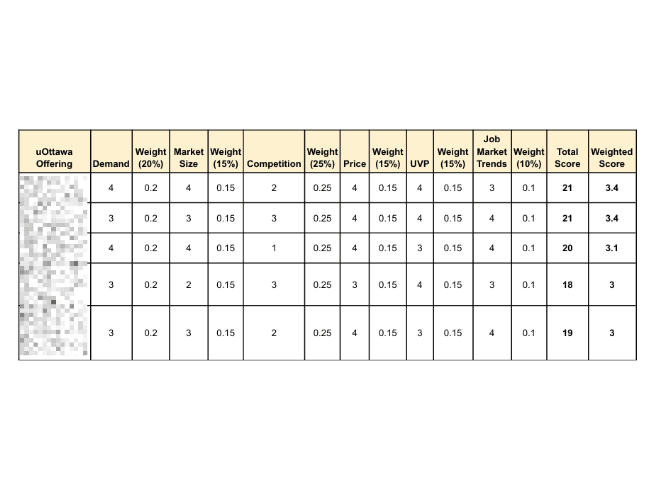
Fractal synthesized the findings into a scoring model that ranked programs using four key criteria: market demand, brand alignment, operational feasibility, and financial viability. This allowed uOttawa to make objective, data-driven choices combining quantitative indicators like job growth and keyword trends with qualitative insights from faculty leadership and industry advisors.
Top Program Offerings Report
Fractal distilled the research into a comprehensive Top Program Offerings Report, translating complex data into clear strategic direction, including a prioritized portfolio of high-potential programs across degree and professional levels, program opportunity snapshots showing audience segments, differentiators, job outcomes, and go-to-market considerations, and a rollout roadmap sequencing which programs should launch first based on readiness and market timing.
The Results
This project provided the University of Ottawa with a data-backed roadmap for digital expansion and a repeatable model for ongoing program planning. Fractal’s integration of job market analytics and search behaviour insights grounded decisions in real-world demand and narrowed a broad inventory of programs into a concise, high-impact portfolio.
Beyond the Narrative
The top program offerings report revealed several program areas where market demand and uOttawa’s strengths intersected, fields linked to workforce gaps, emerging technologies, and public-sector innovation. It also identified “quick-win” offerings that could launch within a year and generate early proof of success while longer-term initiatives matured.
Through this work, the University moved from digital aspiration to action equipped with the data, strategy, and confidence to lead in Canada’s next chapter of accessible, technology-driven higher education.
Have a difficult communications problem? Reach out, we’re always happy to chat.